Who invented electricity? No single person did. Electricity is a natural energy that was discovered, not invented. People like Benjamin Franklin, Alessandro Volta, and Michael Faraday found ways to harness and generate it. But if you are looking for the specific names behind who invented electricity, you need to look at a timeline of pioneers.
Benjamin Franklin’s kite experiment proved lightning is electricity, but the story began over 2,000 years earlier. Across centuries, early discoveries in physics gradually turned static sparks into the energy powering our homes today. In this article, we’ll cover key discoveries in chronological order and explain exactly who invented electricity through their specific contributions.
What Is Electricity? A Simple Definition
Before we discuss who invented electricity, remember it is a basic natural force - the flow of electric charge.
- Static Electricity: A build-up of charge on an object (like a balloon rubbing against hair).
- Current Electricity: A flow of charge through a conductor (like power in a wire).
Humans did not create electricity; we learned to use it. To see modern applications, check out our guide on AI tools for productivity that rely on electricity. This distinction is important when asking who invented electricity.
Ancient Observations: The First Sparks
Before we explore the breakthroughs of modern science and answer who invented electricity, let's trace the earliest recorded observations of electricity, beginning in ancient times and proceeding chronologically.
Thales of Miletus & Amber
Around 600 BC, Greek philosopher Thales of Miletus made the first recorded observation of static electricity. He noticed amber rubbed with animal fur could attract light objects. Believing it was magnetism, his work still began the earliest observations of electricity, long before anyone asked who invented electricity.
The Parthian Battery
In the 1930s, archaeologists found clay pots near Baghdad dating to around 250 BC, which were several centuries after Thales’ amber experiments. These pots had copper cylinders and iron rods and may have been used for early electroplating, though this is debated.
Key Historical Figures in Electricity
From the 17th to the 19th centuries, interest in electricity transitioned from theoretical curiosity to practical applications. Below is a chronological list of key figures from this period, outlining how each advanced our understanding and answering who invented electricity.
William Gilbert: The Father of Electrical Science
In 1600, English doctor William Gilbert published De Magnete. He first used New Latin - 'electricity' comes from this. Gilbert showed that magnetism and static electricity differ, starting electromagnetism studies. This distinction marked the start of modern electromagnetism and the scientific quest to find who invented electricity.
Benjamin Franklin: Electricity & Lightning
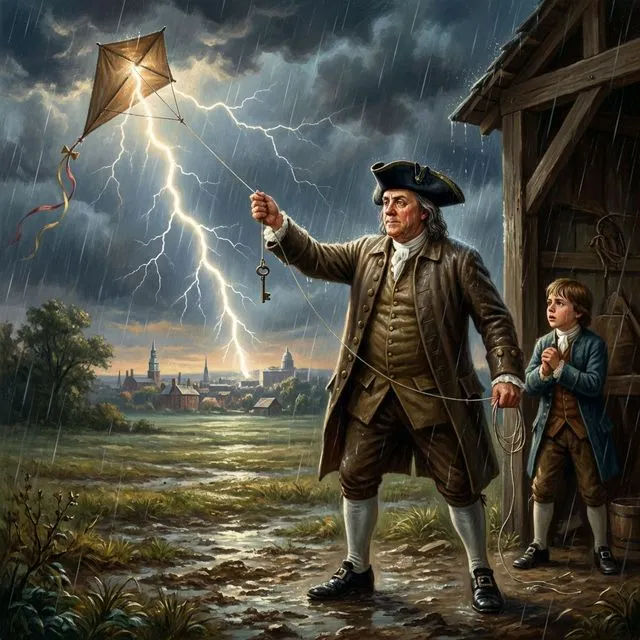
One of the best-known stories about who invented electricity is Benjamin Franklin’s experiment. In 1752, Franklin flew a kite during a thunderstorm.
He collected a charge in a Leyden jar, an early capacitor. This proved that lightning is a powerful form of static electricity. Attribution: Proved lightning is electricity. Coined terms like "positive" and "negative" charge. Learn more about his role in the story of who invented electricity at the Franklin Institute.
Alessandro Volta: The First Battery
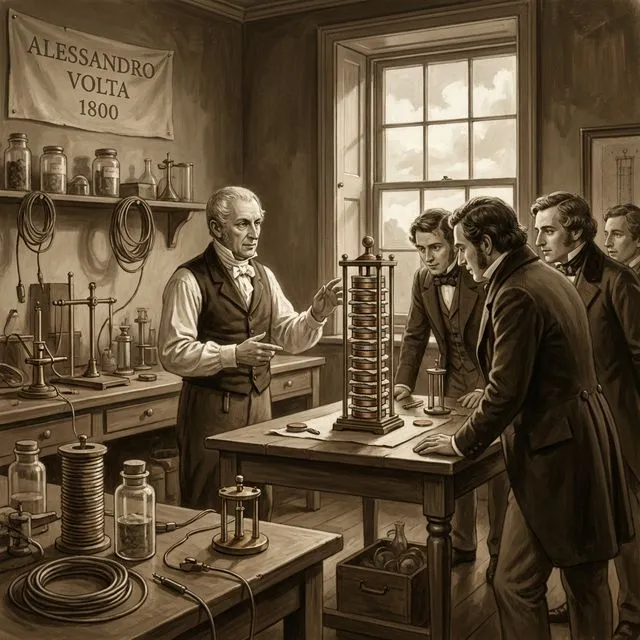
Who invented electricity in the form of a current? While others studied static shocks, Italian physicist Alessandro Volta shifted the focus in 1800. He invented the "Voltaic Pile," the world’s first practical electric battery, providing steady, continuous current rather than sparks.
Legacy: The unit of electric potential, the "Volt," is named after him, cementing his place in the history of who invented electricity.
Michael Faraday: The Father of the Electric Motor
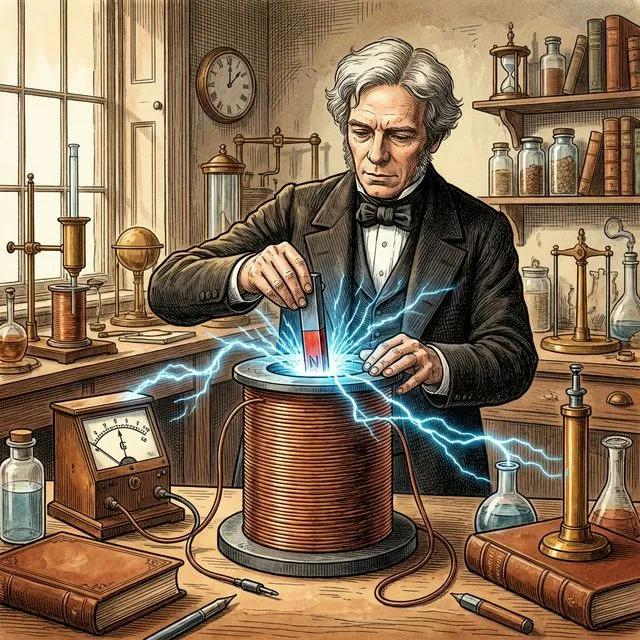
If Volta provided the battery, Michael Faraday provided the engine. In 1831, Faraday discovered electromagnetic induction.
He found that this principle, still used today, led to his inventions of the electric generator and motor. He is a primary candidate for who invented electricity generation. For more, visit the Nobel Prize archives.
James Clerk Maxwell: Unifier of Electromagnetism
In 1865, Scottish physicist James Clerk Maxwell created Maxwell’s equations. These equations brought together electricity, magnetism, and light into one theory.
His work became the foundation for modern physics and all electromagnetic technology, a crucial step in the story of who invented electricity.
Thomas Edison & Nikola Tesla: The War of Currents
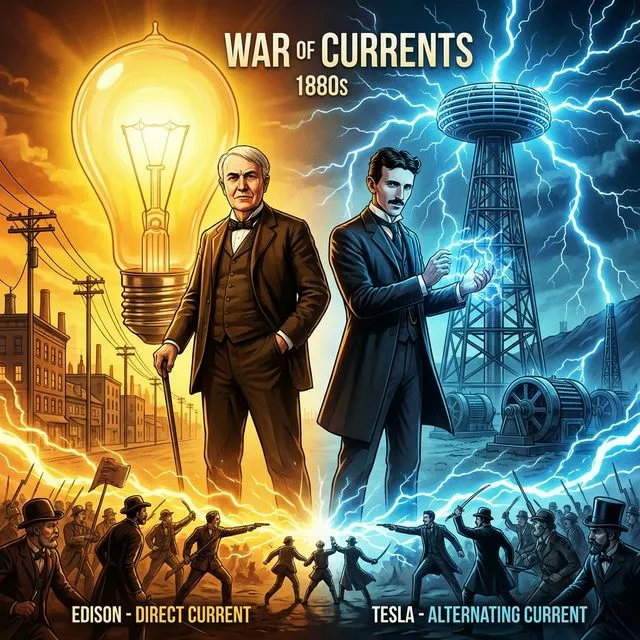
By the late 1800s, inventors competed to bring electricity to more people. This period, called the 'War of Currents,' determined how the world would receive its power and defined who invented electricity for the masses.
Thomas Edison championed Direct Current (DC).
- The Tech: DC flows in one direction (like a battery).
- The Pros: It was safer at low voltages and worked well for incandescent bulbs. The downside was that it could not send power over long distances without thick, expensive copper cables and frequent power stations. George Westinghouse supported Alternating Current (AC).
- The Tech: AC periodically reverses direction.
- The advantage was that with transformers, AC voltage could be increased to travel hundreds of miles and then lowered again for safe use in homes.
- Ultimately, Tesla’s AC system became the standard for today’s global power grid.
The Mathematical Pioneers: Ohm and Ampère
Before people could use electric lights, math had to be solved. Two important, often overlooked, contributors to the question of who invented electricity are:
André-Marie Ampère (1820s)
A French mathematician who founded the science of electrodynamics. He found that wires carrying electric current can attract or repel each other, just as magnets do. The unit of electric current, the Ampere (Amp), is named after him (1827)
He was a German physicist who explained the basic relationship between voltage, current, and resistance. Ohm’s Law (V = IR) is a key rule in modern electronics. The unit of electrical resistance, the Ohm, is named after him.
Electricity in Nature: Bioelectricity
Long before Thales rubbed amber, and long before anyone asked who invented electricity, it was already at work in nature.
- Bioelectricity: Luigi Galvani (1780s) discovered that electricity could make a dead frog's legs twitch. This proved that electricity drives biological movement.
- Electric Eels: Can generate shocks of up to 860 volts to hunt or defend themselves.
- The human body: Our brains, hearts, and muscles all work using tiny electrical impulses. Every thought you have is a tiny electric signal moving across your neurons.
The Future of Electricity
The story of who invented electricity is history, but the future is still going on. We’re moving away from fossil fuels and starting to get more energy from nature.
- Wireless Power: Tesla dreamed of wireless transmission. Modern tech is finally catching up with wireless charging for phones and even electric vehicles (EVs). According to the U.S. Department of Energy, renewable energy grid integration is the next frontier.
- Smart grids are power systems that use AI to automatically balance energy loads.
- Fusion energy is another area where scientists are trying to copy the sun’s process to create unlimited, clean electricity.
Timeline of Major Milestones in Electricity
| Year | Pioneer | Discovery / Invention | Impact |
|---|---|---|---|
| 600 BC | Thales of Miletus | Static electricity with amber | First recorded observation |
| 1600 | William Gilbert | Coined "Electricus" | Distinguished electricity from magnetism |
| 1752 | Benjamin Franklin | Kite Experiment | Proved lightning is electricity |
| 1780 | Luigi Galvani | Bioelectricity | Discovered animal electricity (frog legs) |
| 1800 | Alessandro Volta | Voltaic Pile (Battery) | First continuous electric current |
| 1820 | André-Marie Ampère | Electrodynamics | Explained magnetic effects of currents |
| 1827 | Georg Ohm | Ohm's Law | Defined Voltage, Current, Resistance connection |
| 1831 | Michael Faraday | Electromagnetic Induction | Enabled electric power generation |
| 1865 | James Clerk Maxwell | Maxwell's Equations | Unified electromagnetism theory |
| 1879 | Thomas Edison | Practical Light Bulb | Commenced the age of electric lighting |
| 1882 | Thomas Edison | Pearl Street Station | First commercial power plant |
| 1887 | Nikola Tesla | AC Induction Motor | Enabled long-distance power grids |
Why "Who Invented Electricity" Is a Complex Question
There’s no single answer to who invented electricity because electricity has three "lives" in history.
- As a science, it is defined by Gilbert, Franklin, Ohm, and Ampère.
- As a Utility: Engineered by Volta, Faraday, Tesla, and Edison (history of electric power).
If you ask, "Who invented the light bulb?" most people say Edison. But when it comes to who invented electricity itself, it was a team effort by many people over time.
Looking back, it’s clear that electricity’s impact extends far beyond its discovery. It fueled the Second Industrial Revolution and transformed societies.
- Industrial: Shifted factories from steam to electric motors.
- Domestic: Paved the way for refrigerators, radios, and computers.
- Medical: Enabled X-rays, MRIs, and life-saving medicine. Today, progress continues with electric vehicles and renewable energy.
Who is the father of electricity?
This title is often shared when asking who invented electricity. William Gilbert is the father of electrical science. Michael Faraday is often called the father of the electrical age. Benjamin Franklin is the father of American electrical theory. Nikola Tesla is often called the father of modern electricity for his AC system.
When was electricity first used in homes?
Practical home electricity began in the late 1800s. Thomas Edison's Pearl Street Station (1882) was the first central power plant, bringing electric light to a small section of New York City. Widespread adoption of home electricity began in the late 1800s. Thomas Edison’s Pearl Street Station (1882) was the first central power plant, bringing electric light to part of New York City. Widespread adoption came 50 years later. Periodically reverses direction and is used in power grids because it transmits over long distances more efficiently.
Why is it called "electricity"?
The word comes from the Greek word "elektron", which means amber. The ancient Greeks discovered static electricity by rubbing amber with fur and started the journey to defining who invented electricity. William Gilbert later Latinized this to "electricus" in 1600.
Who really invented the light bulb?
While Thomas Edison patented the first commercially practical incandescent bulb in 1879, he wasn't the first to create electric light. British inventors like Humphry Davy (the arc lamp) and Joseph Swan (the incandescent bulb) had working prototypes years earlier. Edison's genius was creating a long-lasting filament and the entire power system to run it.
Conclusion
So, who invented electricity? It was not just one person. The discovery was like a relay race, starting with the ancient Greeks and continuing through the work of Benjamin Franklin, Alessandro Volta, and Michael. Nature created the force of electricity, but these pioneers built the world we live in today by learning how to use it. If you want to learn more about scientific discoveries, check out our other articles on the history of technology and innovation.